
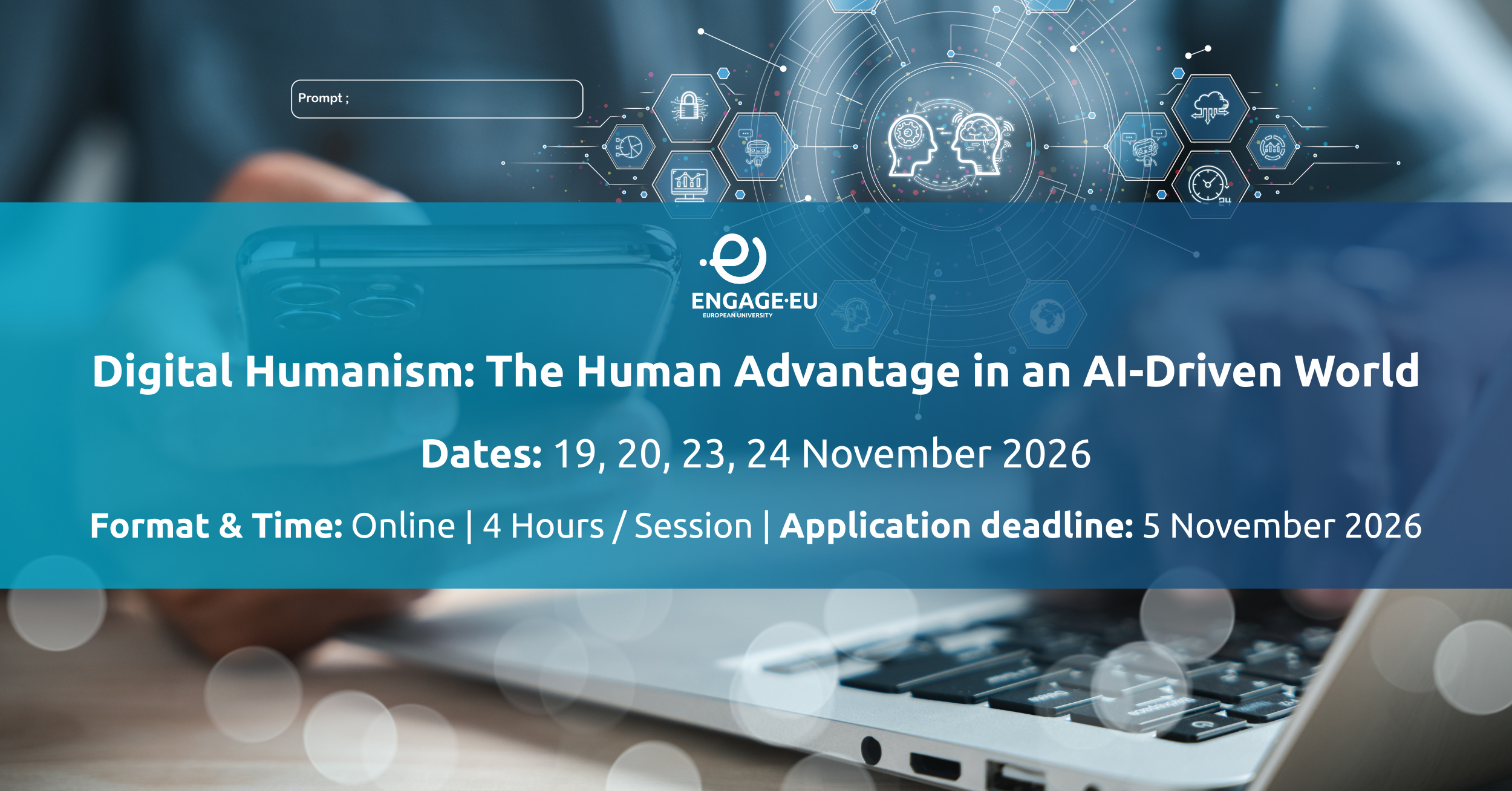
Artificial intelligence transforms how we work, communicate, make decisions and participate in society. This interactive online programme explores how digital transformation can be shaped responsibly, with human values, democratic principles and accountability at its centre.
How can we make sure that technology serves people, and not the other way around?
The ENGAGE.EU Practitioner Programme Digital Humanism: The Human Advantage in an AI-Driven World invites participants to explore the opportunities, risks and responsibilities of AI-driven societal change. Based on the four principles of Digital Humanism, the programme combines theoretical perspectives with practical cases, simulations and interactive discussions.
Participants will reflect on the role of humans, organizations and employees in shaping digital transformation responsibly.
About the Programme
Digital technologies and artificial intelligence are already changing the way we consume, interact, do business and engage with media and politics. As a result, individuals, organizations and society are confronted with important questions about the potential and challenges of this digitally and AI-driven transformation.
Digital Humanism provides a framework for addressing many of these questions. Originating from the work of Julian Rümelin and Hannes Werthner, and reflected in the Vienna Manifesto and the EU Digital Rights Charter, it places human values, rights and well-being at the center of technological development and digital transformation.
The programme introduces participants to Digital Humanism in theory and practice. Through lectures, case studies, simulations and personal experience, participants will explore how digital and AI-driven transformation can be shaped responsibly in business, administration and civil society.
What You Will Learn
In this programme, participants will:
- understand the core ideas and principles of Digital Humanism;
- explore the role of individuals, organizations and society in AI-driven transformation;
- reflect on how digital technologies and AI affect business, administration and civil society;
- discuss human-AI interactions, societal change, standards and methods;
- work with cases related to AI governance, AI compliance and AI ethics;
- engage with key topics such as data protection, IP law and copyright;
- examine how technology can support, rather than replace, human judgement, responsibility and interaction;
- explore the four core principles of Digital Humanism: human-centred and democratically grounded technology, tech-augmentation with human accountability, transparency, privacy and rule of law, as well as fairness, inclusion and sustainability.
The Four Core Principles
Technology should be designed around human needs, capabilities and values. Digital systems should enhance human autonomy, creativity and well-being, while supporting democratic participation and fundamental rights.
Participants will explore how user-friendly and inclusive systems can be designed and how values can be translated into technological development and organisational practice.
AI and digital technologies should support human capabilities, not replace human judgement, responsibility and interaction. While automation can increase efficiency, decisions that affect people’s lives must remain under meaningful human control.
This part of the programme focuses on human-AI interaction, human oversight, legal frameworks and the responsibilities of organisations and AI providers.
Digital systems must be transparent, understandable and accountable. Users and stakeholders should be able to understand how decisions are made, especially when AI is involved.
Participants will discuss explainable AI, documentation of data use and algorithms, data protection, intellectual property, high-risk AI systems and accountability mechanisms.
Digital transformation should benefit society as a whole. AI systems can unintentionally reinforce existing biases in data and society, which makes fairness, accessibility and inclusion essential.
This part of the programme addresses bias in algorithms, equal access to digital technologies, inclusion and diversity, and the environmental sustainability of digital transformation.
Structure of the Course
The programme consists of four interactive online sessions of four hours each. The programme consists of four interactive online sessions of four hours each. Participants can choose to attend the full programme or selected individual sessions. A Certificate of Participation will be awarded to those attending all four programme days.
Date: 19 November 2026
Lecturer: Martin Giesswein
The first session introduces the history, principles and practical relevance of Digital Humanism. Participants will explore how human-centred and democratic values can guide digital transformation and the design of inclusive systems.
Topics include:
- welcome, programme overview and expectations;
- history and principles of Digital Humanism;
- value-based engineering and inclusive system design;
- real-life cases and interactive discussion;
- competences needed for Digital Humanism in a democratic society.
About the lecturer:
Martin Giesswein is the AI Program Director at the WU Executive Academy, focusing on artificial intelligence, the digital economy, and leadership. He is the author and editor of several books on artificial intelligence, digital leadership, and future-oriented organizational development. In 2025, he was awarded with the “Digital Humanism in Practice” price. He serves as an AI Ethics Advisor for the European DRAIGON project. He is one of the co-initiators of DigitalCity.Wien, a long-standing collaboration between the digital economy and the City of Vienna that has shaped Vienna’s innovation landscape for more than a decade. Prior to his academic and advisory work, he served as CEO and General Manager with immobilien.net and Nokia.
Date: 20 November 2026
Lecturer: Sophie Martinetz
The second session focuses on the interaction between humans and AI. It explores how technology can support human work and decision-making while preserving responsibility, accountability and legal certainty.
Topics include:
- human interaction with AI;
- human control and oversight;
- legal frameworks for AI use;
- ethical considerations in AI-supported legal work;
- strategies and liabilities of AI vendors.
About the lecturer:
Sophie Martinetz is a renowned Austrian entrepreneur and pioneer in the field of legal tech. As the founder and CEO of Future-Law, she advises legal departments and law firms on digital transformation, with a strong focus on digital humanism and the responsible use of AI. Before her success as an entrepreneur, the lawyer gained international management experience at major corporations such as Barclays Bank in London and BAWAG PSK in Vienna. The multi-award-winning expert (including “Woman of Legal Tech”) also serves as a lecturer and mentor and plays a key role in shaping the debate on innovative work models and the future of the legal market in Europe. She is the founder and co-director of the WU Legal Tech Center, which researches public law issues related to the digital application of law, as well as the impact of advancing digitalization on the working lives of lawyers, the lives of citizens, and the democratic rule of law in general.
Date: 23 November 2026
Lecturer: Antitsa Geneva
The third session examines how transparency, explainability, privacy and legal frameworks shape the responsible use of AI and digital technologies.
Topics include:
- explainable AI;
- data protection and privacy;
- documentation of data use and algorithms;
- intellectual property and copyright;
- accountability mechanisms and high-risk AI systems.
About the lecturer:
Antitsa Geneva is a Chief Assistant Professor in the Department of International Law and EU Law at the University of National and World Economy (UNWE), where she focuses on intellectual property, EU law, digital regulation, and artificial intelligence. Prior to joining academia, she gained extensive professional experience in intellectual property, media, and corporate law. Her experience includes serving as a member of the legal team at a technology company specializing in data analytics, digital platforms, and information security; as Country Legal Counsel for Bulgaria and a member of the Balkans legal team at a leading global entertainment company; and as legal counsel for a copyright collective management organization. As part of her continuing professional development, she has completed specialized courses in intellectual property at Harvard Law School, Berklee College of Music, and the World Intellectual Property Organization (WIPO).
Date: 24 November 2026
Lecturer: Dr. Ricardo Mejía
The final session addresses the societal impact of digital transformation and explores how AI can be developed and used in ways that are fair, inclusive and sustainable.
Topics include:
- bias and discrimination in AI systems;
- accessibility and equal access to digital technologies;
- inclusion and diversity;
- environmental sustainability;
- applying Digital Humanism in practice.
About the lecturer:
Dr. Ricardo Mejía-Fernández is a philosopher and university professor specialized in contemporary philosophy, with a particular focus on the philosophical challenges posed by the digital revolution, artificial intelligence, and transhumanism. He holds a PhD in Logic and Philosophy of Science and has conducted research in international academic institutions, including the Sorbonne, UC Louvain or the London School of Economics and Political Science (LSE). He is currently a professor at La Salle Ramon Llull University in Barcelona, where he combines teaching, research, and institutional responsibilities. His research explores the relationship between technology, human nature, cognition, and the future of humanity.
Target Group
This programme is designed for university members, professionals and Master’s-level participants who want to better understand the human, organizational and societal implications of AI-driven transformation.
It is particularly relevant for participants interested in:
- artificial intelligence and digital transformation;
- responsible leadership and governance;
- public administration and policy;
- business, management and innovation;
- law, compliance and data protection;
- ethics, sustainability and societal impact.
A technical background is not required. The programme is open to participants who are interested in the responsible use and governance of digital technologies. Professional experience is recommended.
Method and Learning Format
The programme takes place fully online and is delivered in English.
Each session combines expert input with interactive elements, case studies, simulations and discussions. Participants are encouraged to bring in their own professional and organisational perspectives.
The format is designed to be practical, interactive and interdisciplinary.
Interested in joining the programme?
If the programme matches your interests and you would like to participate, we invite you to apply using the application form below.
If you have any questions about the programme, the application process or participation requirements, please feel free to contact:
digitalhumanism-programme@wu.ac.at
or
Sonja-Victoria Walter, MA
WU Executive Academy
sonja-victoria.walter@wu.ac.at
Apply Here
Places may be limited. Applicants will be informed about the outcome of their application by email.