How can students help shape the decisions of European university alliances—and ensure that their contributions make a difference? That question guided the Online Student Representation Workshop organised by the ENGAGE.EU Board of Learners on 28 October 2026. Student representatives from several European university alliances shared their experiences and discussed how to make student participation more influential, inclusive and sustainable.
The workshop provided a platform for discussions about ENGAGE.EU’s own representation model and developed recommendations for its future governance. These will feed into the next governance steps and preparations for the Erasmus+ funding proposal covering 2027–2029.
From representation to influence
The ENGAGE.EU Board of Learners (BoL) currently comprises 18 student representatives from the ten partner universities. Two representatives participate in the Executive Committee and one in the Governing Board. They attend meetings, raise issues and advise the governing bodies, although their role is currently primarily consultative, while voting rights remain under discussion.
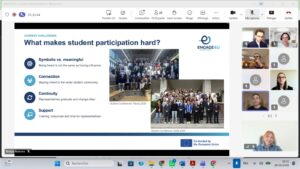 The workshop highlighted a central challenge: meaningful representation requires more than simply giving students a seat at the table. Students need opportunities to contribute to decisions, clear responsibilities and feedback on how their recommendations are considered.
The BoL’s work already extends beyond governance meetings. It connects Bachelor’s, Master’s, doctoral and alumni communities through student-led activities, conferences and online events, while participating in European forums such as the European Student Assembly, FOREU4ALL and EUSAF. The workshop examined how these connections could support a stronger role within the alliance itself.
Experiences from other European university alliances offered valuable insights into how this can work in practice. EC2U, for example, uses a student ambassador model with representatives at each partner university, supported by training and regular meetings. E³UDRES² combines a general student board with an executive board, giving representatives opportunities to contribute to discussions and decisions. CIVICA, meanwhile, involves students in assessing proposals for its Student Engagement Fund, which provides grants of up to €10,000 for student-designed projects.
These examples demonstrate that student involvement can take different forms, from bringing alliance activities closer to local student communities to giving students a direct role in shaping and supporting initiatives.
 “Student ambassadors help connect an alliance with everyday student life. Training, regular meetings and opportunities to organise local activities give them the tools to make that connection meaningful.” – Alexandra-Ioana Simon (Guest Speaker | ESN Romania, Alliance Ambassador (EC2U)
Making participation meaningful and sustainable
Beyond formal representation structures, the workshop highlighted the importance of practical support, visibility and continuity.
Contributions from the Erasmus Student Network (ESN) demonstrated how surveys and impact evaluations can  help bring students’ everyday experiences into discussions with decision-makers. As Manish Rathi, Secretary of ESN Uni Turku, emphasised:
“Student advocacy needs evidence from students’ lived experiences. Surveys and impact evaluations help us bring those experiences to decision-makers, but the feedback loop matters too: students should be able to see what happened to their input.”
 “Meaningful participation needs practical support. Payment, clear responsibilities and regular contact help students sustain their involvement, while direct connections with the people leading alliance activities create opportunities to influence the work.” – Gaia Freund (Guest Speaker | Vice-chair of UNIC Student Board)
Recommendations for ENGAGE.EU
Building on these experiences, participants developed recommendations for strengthening student representation within ENGAGE.EU. Key priorities included:
Clearer representation structures: Democratic selection procedures, clearly defined rights and responsibilities, and greater involvement in setting agendas and shaping decisions.
Stronger connections with students: Closer cooperation with existing student organisations and academic departments, alongside better communication and outreach.
Greater recognition and support: More institutional support, realistic workloads and appropriate recognition of the time and expertise students contribute.
Transparency and accountability: Regular feedback on which student recommendations are adopted and why others are not, helping students understand the impact of their involvement.
Continuity and knowledge-sharing: Stronger networks, longer terms of office and mechanisms to preserve knowledge when representatives change.
Participants also stressed that student contributions should not be measured by attendance figures alone. The impact of representation depends on what students contribute, what actions follow and how their involvement influences decisions and activities.
For the ENGAGE.EU Board of Learners, ensuring continuity remains a particular challenge. Minimum two-year terms have already been introduced at most partner universities, while student conferences and networks help maintain connections across changes in membership.
 Turning recommendations into action
Closing the workshop, Annalisa Bonavita, Co-chair of the Board of Learners highlighted the importance of translating the discussions into concrete improvements. The recommendations and feedback will inform the Board’s next governance steps and the forthcoming Erasmus+ proposal. A document summarising the workshop’s outcomes will also be circulated among participants.
The next challenge is to turn these recommendations into governance arrangements that give students timely access to decisions, adequate support to participate and a clear account of what their involvement achieves.