
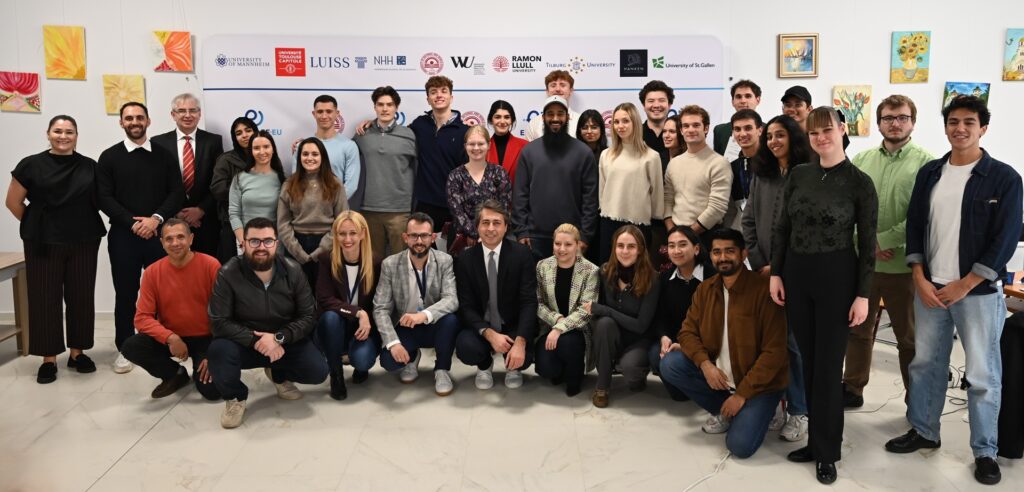
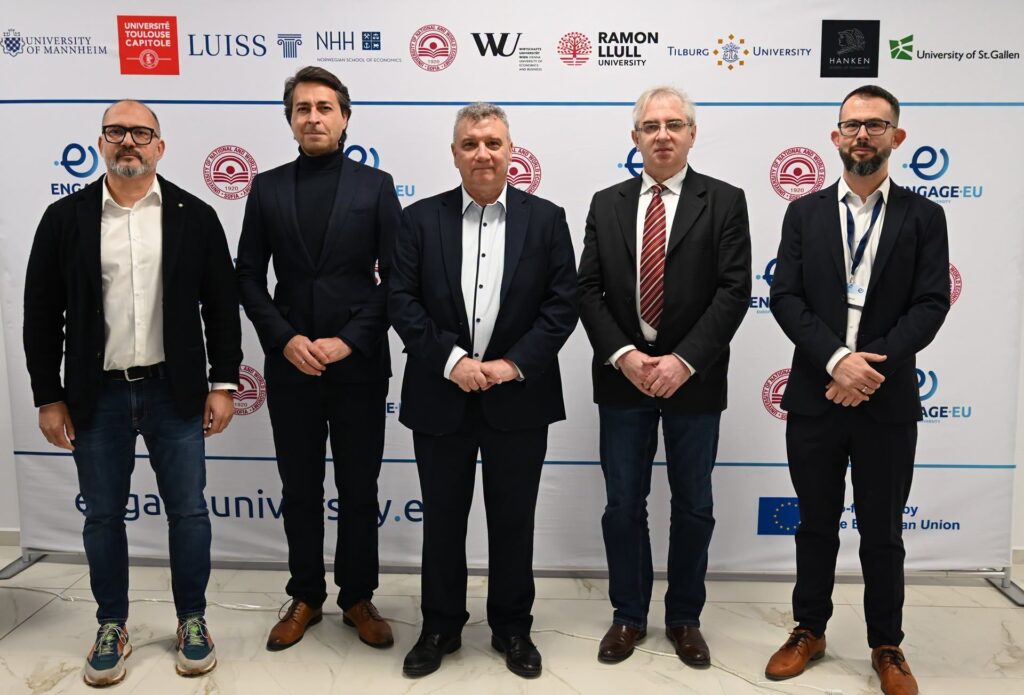
 The participants were welcomed by the Rector of UNWE, Prof. Dr Dimitar Dimitrov, together with Assoc. Prof. DSc Mihail Musov, ENGAGE.EU Institutional Coordinator, and Assoc. Prof. Dr Kostadin Kolarov, Head of the Department of Entrepreneurship and Director of the UNWE Institute of Entrepreneurship.
Also present were Senior Assist. Prof. Dr Kristian Zhelev from the Department of International Economic Relations and Business; Senior Assist. Prof. Dr Maria Dimitrova from the Department of Real Estate; Elitsa Karamiteva from the International Relations Directorate, Secretary to the Vice-Rector for International Affairs; and the week’s keynote speaker, Mr. Georgi Robev – Member of the Management Board of the Association for Sustainable Development of Artificial Intelligence. All of them wished the participants a productive and inspiring week.
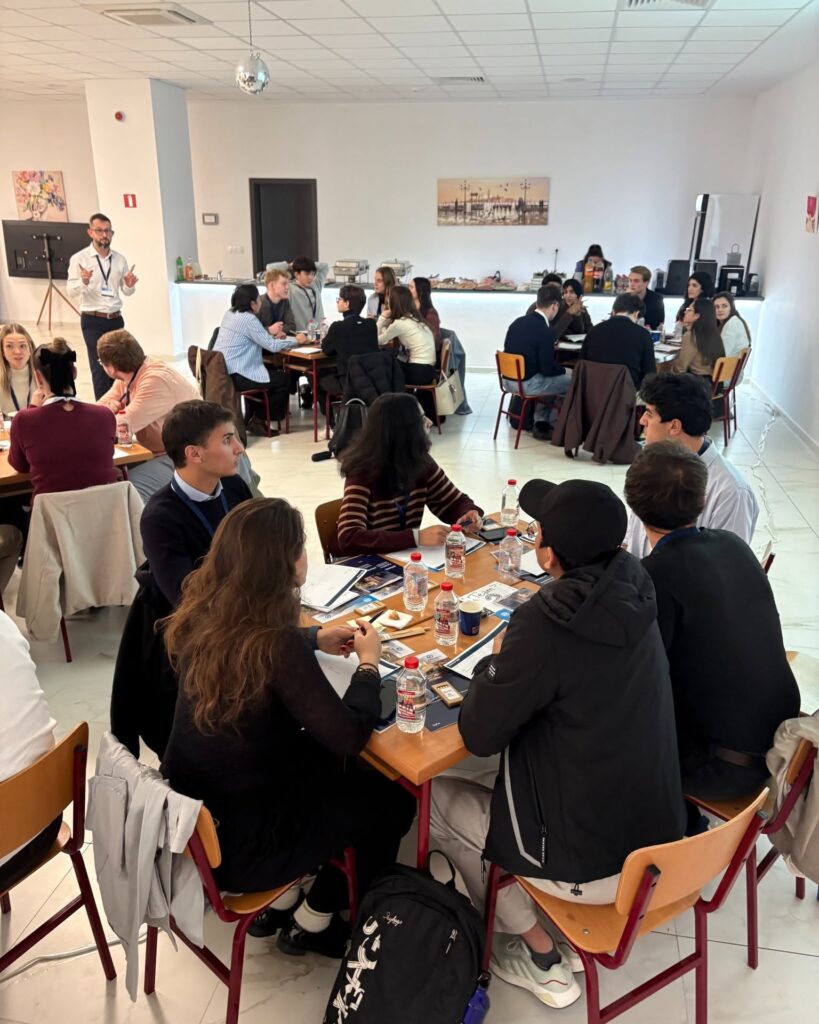 A total of 35 students and doctoral researchers are taking part: nine from Luiss Guido Carli University in Rome, six from the University of Mannheim, five each from Université Toulouse Capitole and WU Vienna University of Economics and Business, three from Ramon Llull University in Barcelona, two each from NHH Norwegian School of Economics, Tilburg University and UNWE, and one from Hanken School of Economics in Helsinki.
Working in interdisciplinary teams, they are tackling four challenges: rethinking academic incentives; creating time and space for entrepreneurship; bridging the gap between academia and industry; and new this year, using artificial intelligence to commercialise research.
The central challenge identified was a structural misalignment within the academic system. Universities reward researchers mainly for publications and teaching, while commercialisation is largely left out of the incentive structure. Researchers are given no dedicated time for it, and in some cases pursuing it can work against their career progression. This imbalance is reinforced by several factors: bureaucratic inertia that slows institutional change, rigid regulatory frameworks that limit flexibility, and a persistent cultural divide between academia and industry. Together, these conditions make it difficult for academic research to move beyond the university and into practical or commercial use.
Among the jury members and guest lecturers was Ivan Dimov from the Bulgarian Angels Club, himself a UNWE alumnus. Reflecting on the connection between academic learning and entrepreneurial practice, he said: “I shared with the students that events such as this one play a key role in connecting academia with practice and bringing the business world closer to them. As a jury member, I had the opportunity to explain what they need to focus on to impress investors, but, most importantly, how to develop the emotional intelligence to receive feedback and apply it to their future projects.”
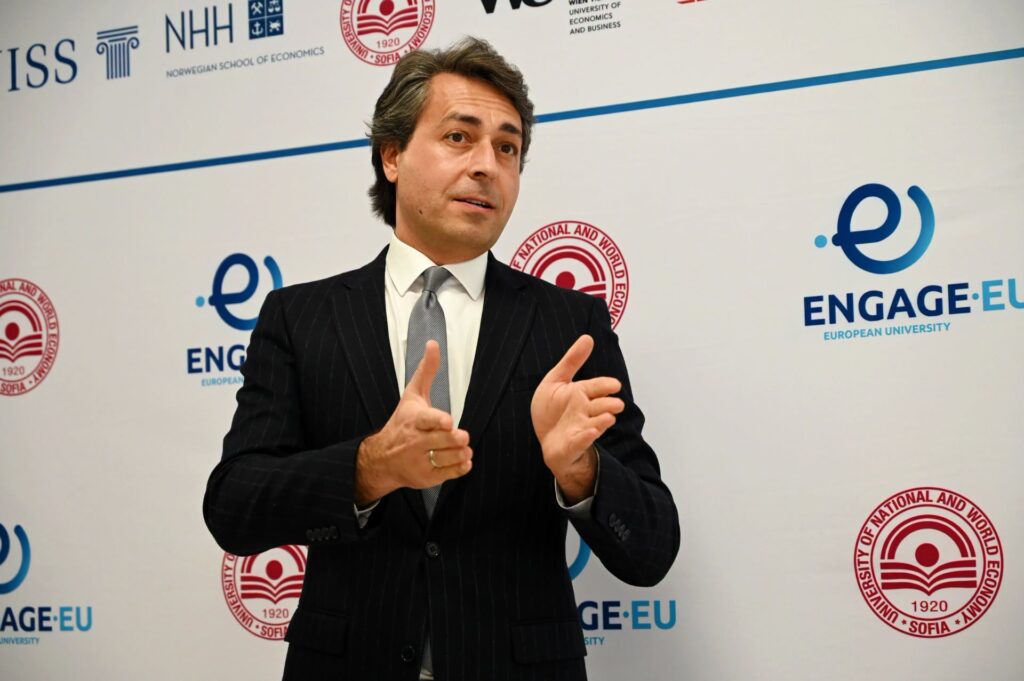 The Expedition+ Week concluded with a closing ceremony led by Assoc. Prof. Mihail Musov, DSc, ENGAGE.EU Institutional Coordinator at UNWE, who presented all participants with certificates of participation and small prizes in recognition of their contributions throughout the programme.
Participants highlighted the value of international teamwork and the opportunity to develop ideas together. One participant shared: “For me, the greatest impact of the event came from the multicultural experience. I worked with students from different backgrounds, and it was interesting to see how my ideas developed from scratch through our collaboration.”
For another participant, the week marked the beginning of their involvement with the alliance: “This is my first time participating in an ENGAGE.EU event, but it won’t be my last. These events are truly relevant to my academic background, and the examples shared throughout the week helped me see how theory connects with practice.”
The closing ceremony celebrated five days of shared learning, interdisciplinary collaboration and idea development, with participants reflecting on both the professional insights and the personal connections they gained.
The ceremony brought a week of shared learning, experimentation and international teamwork to a close. Participants left with new connections and perspectives on how research can move beyond academia, alongside practical experience in developing ideas, presenting proposals and responding to feedback.