Menu Close

ENGAGE.EU Joint Programme in Digital Transformation

Prepare yourself for a digital future

The world is changing fast. The Joint Programme in Digital Transformation equips you with the latest technology skills and knowledge to understand data, leverage digital disruption, create societal impact, prepare yourself for a digital future that is happening now, and become a digital change maker.

In this programme, you will have the opportunity to work with some of the largest tech and digital companies in innovative case studies and workshops. As a culmination, the programme ends with an in-person summer seminar at one of the nine partner universities, where you will meet your cohort, practically apply your knowledge from the courses, and expand your network.
Programme Overview & Structure

  • Degree: Add-on certificate in masters level (honours programme)
  • Standard period of study: 1 semester
  • ECTS credits: 6 ECTS will be awarded for each virtual course plus 2 ECTS for the in-person summer seminar, which makes 20 ECTS in total.
  • Course recognition: As the programme is an independent, add-on certificate, there is no automatic recognition of grades into your degree. The past two years showed, however, that recognition might still be possible depending on the school and study programme – please check with your local contact for course recognition.
  • Language of instruction: English
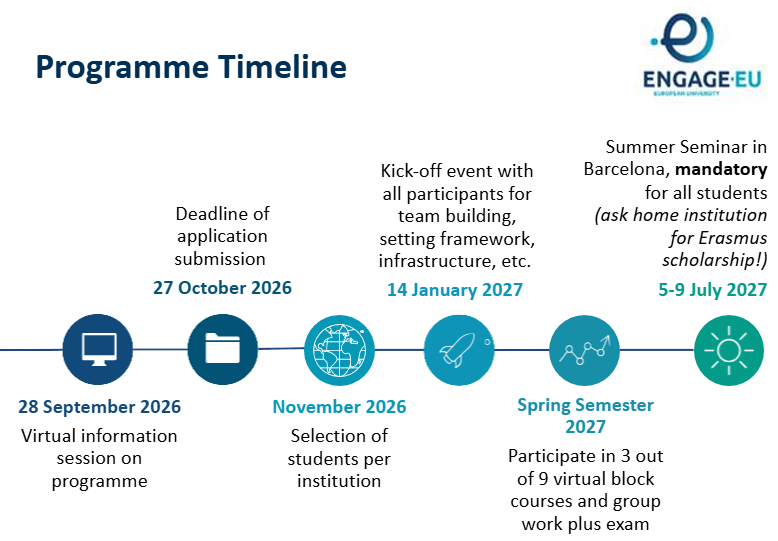
  • Programme timeline: Application from 1 to 31 October 2025, kick off and courses in spring semester from January to June + summer seminar in July
  • Universities: University of Mannheim, Luiss University, NHH Norwegian School of Economics, Tilburg University, University of National and World Economy, Université Toulouse Capitole, WU Vienna University of Economics and Business, Ramon Llull University, Hanken School of Economics

The Joint Programme in Digital Transformation addresses the world’s greatest digital transformations, technologies, and solutions, offering students the opportunity to enhance their skills and prepare for a digital future through cutting-edge courses. 

As a student enrolled in the Joint Programme in Digital Transformation, you can design your studies individually and flexibly in accordance with your ideas and preferences. You can choose three out of seven courses offered by the various partner institutions of ENGAGE.EU. All courses are taught as virtual block courses over two weekends. 

The Joint Programme in Digital Transformation is topped off by a mandatory in-person summer seminar taking place in July 2026 at one of the partner universities.

  • The programme will be launched in fall 2025 with an information and marketing campaign, followed by live in-depth information session at each university. The application and selection period will take place during the Fall semester 2025.
  • Each course will be delivered in a ‚block‘ format on Fridays and Saturdays. As a student in the Joint Programme, you choose three out of the seven courses to suit your interests as well as to complement rather than duplicate topics that might be included in your own master’s courses.
  • The virtual block courses of the Joint Programme are offered by the partner institutions.
  • Within each block course, group work and discussions will be organised in multi-competence teams to make good use of the broad range of backgrounds that students come from. The examination format can be defined flexibly to cater for specific requirements, e.g. online exam, team/individual essay, or team presentation, etc.
  • The programme will culminate in a mandatory physical summer seminar meeting in July for all students taking part in the certificate programme. During the seminar, you will get the opportunity to put your acquired knowledge into practice with digital transformation company case studies. At the end of the seminar, you will be awarded with a certificate and with a transcript for the individual courses.
  • The examination regulations of the school at the host university offering each virtual course shall apply to study and examination achievements. This includes class performance standards and other policies of the host institution, including the host university’s/school’s regulations for disadvantage compensation. In cases of failed examinations, the exam regulations of the host university apply. However, to complete the programme and receive the certificate, resits must be taken within the study period of the Joint Programme, latest by the last business day of June 2026.
  • To pass the programme and to receive the Certificate in Digital Transformation, three virtual courses as well as the summer seminar must be successfully completed. The certificates will be awarded at the end of the summer seminar by a senior representative of ENGAGE.EU.

There is no registration fee for the Joint Programme and no tuition fee payable for the virtual block courses. For the one-week obligatory summer seminar, students will come together at the University of Mannheim. There will be scholarship programmes available to support students to cover (at least part of) the summer seminar expenses. These scholarships are offered to students by their home university and may differ from partner to partner. Please contact your local ENGAGE.EU Office or local International Office for further information about funding options.

Please note that accommodation is not included. The University of Mannheim assists by providing accommodation suggestions, but you are not bound to these options.  

Virtual Information Session

The information session took place on 22 September 2025 at 17:00 CET.

You can download the slides and watch a recording of the session:


Course Catalogue

During the spring semester 2026, various courses concerning digital transformation will be offered by the nine partner universities. Download the syllabus for more information.

  • Teaching institution: NHH Norwegian School of Economics
  • Lecturer: Shagun Sarraf
  • Date: 10 – 11 April 2026 & 17 – 18 April 2026
  • Course abstract:

Digital transformation implies an extensive organizational change driven and ena-bled by digital technologies. This could involve changes to the organization’s busi-ness processes, business model, or even a new organizational identity. Such organ-izational change affects employees in different ways and prompts changes to both leadership approaches and leadership roles, which we address in this module.

The course consists of four main overarching topics:

1. Digital concepts and technologies

2. Digital trends

3. the Digital leader

4. the Digital organization

The first day, we will uncover what we mean by phenomena such as digitization, digitalization, digital innovation, and digital transformation. We will discuss charac-teristics of digital technology and look at different examples and cases of how digital technologies could affect the way business is conducted.

The second day, we will look at different “digital” trends, e.g., trends that drive changes in business models and are enabled by digital technologies, such as digi-tal platform ecosystems, sharing economy, and sustainability.

The third day, we will discuss what it implies to be a “digital leader”, including leader attributes and new leader roles, as well as topics related to the responsibilities of the digital leader, such as developing a digital strategy and ensuring the organization’s digital maturity.

The fourth day, we look at how digital transformation changes work design and leadership and discuss how employees might be affected in terms of competency requirements and digital technology adoption.

  • Learning objectives:

Upon completion of this course, the students should be able to…

  • …call out relevant and recent research on digital transformation.
  • …name emerging digital technologies and digital technology-enabled trends.
  • …analyse how emerging digital technologies and digital technology-enabled trends might enable organisational change.
  • …illustrate how digital transformation might affect employees in the organization.
  • …illustrate how managers might support the employees during and after the digital transformation process.
  • …analyse an organisation’s current digital maturity.
  • …recommend measures leaders can take to increase the digital maturity.
  • …name important leader attributes and leader roles are important for managing in a digital age.

Download syllabus

  • Teaching institution: Ramon Llull University
  • Lecturer: Maria Isabel Bellot and Francesc Taxonera
  • Date: 24 – 25 April 2026 & 8 – 9 May 2026

Course abstract:

This course offers a comprehensive view on Data Strategy, designed to equip students with the knowledge and skills needed to harness data as a key driver of organizational success. Aimed at last-year Bachelor’s and Master’s students, they will focus on critical aspects of data management, including governance, architecture, and analytics, while also examining the role of emerging technologies such as artificial intelligence (AI) and the Internet of Things (IoT). Emphasizing real-world application, the course highlights how data can be leveraged to enhance decision-making, foster innovation, and create a competitive advantage. Students will engage in case studies and projects that reflect real-world challenges, developing the ability to craft and implement data strategies that align with organizational goals. By integrating technical skills with strategic thinking, the course prepares students to meet the demands of the modern data-driven landscape. Additionally, key professional competencies such as ethical decision-making, communication, and problem-solving are embedded throughout, ensuring students are ready to lead and innovate in their careers
  • Teaching institution: WU Vienna University of Economics and Business
  • Lecturer: Prof. Dr. Martin Kornberger
  • Date: 16 – 17 January 2026 & 19 – 20 June 2026
  • Course abstract:

Digital Ethics reflects on and intervenes in the zone where technological innovation, economic organization and moral responsibility overlap. At the interface between these domains emerge new questions, challenges and dilemmas of ethics: how does decision making change when AI-powered ma-chines frame and structure the decision-making process? Who is accountable for actions when technology mediates decisions and enhances capacity to act such as in drone warfare? In how far are digitally mediated platform organizations responsible for actions of its users? How do trust and transparency ensure or undermine the legitimacy of digitalization? And how do we negotiate boundaries between surveillance and freedom in data-driven public and private systems? In this course we will focus on these concerns through (1) developing a vocabulary that allows to articulate challenges and dilemmas and through (2) enhancing our repertoire to act on these challenges and dilemmas. The course acts as bridge between ethics, technology and economy, providing tools for thinking about and working with digital ethics.

Download syllabus

  • Teaching institution: Tilburg University
  • Lecturer: Shiva Shekhar
  • Date: 23 – 34 January 2026 & 30 – 31 January 2026
  • Course abstract:

The course introduces the multi-sided platform business model and the importance of platform orchestration and governance strategies. It provides insights on the best practices to successfully interact with existing platforms and optimize the symbiotic relationship, and finally discusses evolution of new technologies into potential platforms. Students will have an opportunity to apply concepts from platform economics and organization using game theoretical tools and case studies to real world problems.

Throughout the course, participants will engage in discussions, case studies, and interactive sessions to reinforce their understanding of digital platforms and how they shape the modern business landscape. By the end of the course, participants will be equipped with the knowledge and tools to navigate the complexities of digital platforms and make informed strategic decisions in this rapidly evolving digital age.

  • Learning objectives:

Upon completion of this course, the students should be able to…

  • …name the most important concepts in digital platforms.
  • …illustrate the basic principles on network effects in multi-sided platform markets and types of platforms.
  • … explain how platforms are designed and how platforms orchestrate interactions between multiple sides and, thereby, create value. 
  • … identify the different types of platforms.
  • …apply the insights from theories in platform markets to platforms in the real world.
  • …interpret platform pricing decisions.
  • …analyze pricing and design strategies employed by platforms and the rationale behind them.

Download syllabus

  • Teaching institution: University of National and World Economy
  • Lecturer: Dr. Sabrina Kalinkova
  • Date: 6 – 7 March 2026 & 13 – 14 March 2026
  • Course abstract:

The course „Strategy Implementation and Performance“ introduces students to modern approaches for translating strategy into action and evaluating organizational performance in the era of digital transformation. It builds on the methodology of the Balanced Scorecard and Strategy maps but adapts these frameworks to the challenges and opportunities of data-driven decision-making, artificial intelligence, automation, and platform-based business models. Special attention is given to the role of intangible assets, digital ecosystems, and the integration of AI in strategic alignment, monitoring, and control. Students will work with case studies to learn how digital tools reshape strategy execution and performance management across industries

Download syllabus

  • Teaching institution: Université Toulouse Capitole
  • Lecturer: Dr. Jamal Azzam and Dr. Nicola Mirc 
  • Date: 6-7 February & 13-14 February 2026
  • Course abstract:

The aim of this course of to introduce students to the challenges of corporate growth in modern digital economies, in particular with regard to accessing and developing digital as-sets and intellectual property. The course is organized in two parts. A first part focuses on the recent developments of the strategic management of patents in modern digital econo-mies. Participants will discover the emergence and the role of the patent system in modern economies and how technological companies try to protect their innovations and to use their patent portfolios in service of their business strategies in a digital era. It covers internal strategies and ways to organize for managing patent and licensing strategies as well as pa-tenting in collaborative arrangements. A second part addresses then more specifically ex-ternal growth strategies to access patents but also more generally digital solutions and as-sets. It addresses in particular the strong increase in technology acquisitions and alliances in past years and introduces students to the particular strategic and organizational challenges that external digital growth induces (i.e. integrating and leveraging acquired intellectual property, transferring knowledge between companies and teams of engineers, implement-ing co-innovative practices between R&D departments from merging companies, etc.).

The course provides students with the relevant knowledge and perspectives to understand the management of intellectual property and growth strategies implemented by firms in modern digital economies. First, the course provides students with a managerial and strate-gic vision of patents, to raise awareness and inform decision-making in this area. Second, students will learn about managerial and strategic challenges of acquiring patents and digi-tal assets in general and how to address them. After this course, students will understand challenges associated with digital growth and intellectual property and are able to develop strategies to deal with such challenges.

  • Learning Objectives:

Upon completion of this course, the students should be able to…

  • …name the recent developments of the strategic management of patents in modern digital economies.
  • …list patenting and licensing strategies.
  • …illustrate the emergence and the role of the patent system in modern economies.
  • …describe options to protect company’s innovations.
  • …recommend decisions for patent portfolios with regard to a company’s business strategy in the digital era. 

Download syllabus

  • Teaching institution: Luiss University
  • Lecturer: Tiziana Scalabrin
  • Date: 20 – 21 February 2026 & 27 – 28 February 2026
  • Course abstract:

This course explores how to engage with ar3ficial intelligence as a prac3cal and strategic tool in academic, crea3ve, and professional contexts. Students will develop the ability to use AI systems cri3cally and construc3vely, learning how to prompt effec3vely, analyze outputs, and apply AI tools to real-world problems. Emphasis is placed on ethical use, sustainability, and long-term thinking. Through team-based ac3vi3es and guided experimenta3on, students will gain the skills to use AI not just as a support tool, but as a means to act responsibly and crea3vely in the age of intelligent systems

Download syllabus

Summer Seminar

The Summer Seminar is the highlight of the whole programme – something to look forward to! It will take at the University of Mannheim, Germany, from 6-10 July 2026

Impressions from the Summer Seminar 2025

Corporate Partners

Application

Application period starts on 1 October 2025 until 31 October 2025, 23:59 CET.

  • The ENGAGE.EU Joint Programme in Digital Transformation is targeted towards students of any citizenship who are enrolled in a master’s programme at an ENGAGE.EU alliance university (University of Mannheim, Luiss University, NHH Norwegian School of Economics, Tilburg University, University of National and World Economy, Université Toulouse Capitole, Vienna University of Economics and Business, Universitat Ramon Llull, Hanken School of Economics).
  • There are no prerequisites for this interdisciplinary programme, and students from diverse backgrounds (such as business, economics, law, social sciences) are encouraged to apply, as long as they have a significant interest in:
    • Exploring digital transformation as a major driver of societal change in Europe
    • Analysing the impact of this transformation in the areas of business, law, and political society
    • Gaining new skills and tools pertinent the digital paradigm shift
    • Developing solution approaches for complex issues arising from digital transformation.
  • To apply for the ENGAGE.EU Joint Programme in Digital Transformation, applicants must provide the following documents (all in English):
    • A  presentation file (Power Point, video, podcast or similar format) explaining what you see as the central challenges in digital transformation facing society today. A Power Point presentation should contain a maximum of 10 slides. A video or podcast should not be longer than 5 minutes. The file should focus on coherent and relevant argumentation of the topic, be innovative and informative, and put across your personal motivation. It should focus on coherent and relevant argumentation of the topic, be innovative and informative, and put across your personal motivation.
    • Academic record (transcript of records incl. list of courses; first year master’s students should upload their bachelor’s transcript)
    • Curriculum vitae (education, work experience, language skills, study/work abroad, other relevant skills and experiences with regards to digital transformation)
  • You will need to select and prioritise three courses out of the seven on offer. In the past, all students were assigned their three priorities and we aim to achieve this again this year
  • When choosing the courses, remember to decide not only based on the course content, but also on your availability on the course dates as well the respective grading criteria of the courses. You must take part in all course dates (weekends) of the course you choose.
  • The Summer Seminar is an in-person, week-long event that all students taking part in the programme will attend, so ensure that you are available during these dates.
    Scholarship options for funding the travel expanses might be available from your home university – please enquire with your local ENGAGE representatives

Each ENGAGE.EU university forms a selection committee made up of academic and administrative staff to evaluate the submitted applications of students from their university. Candidates will be evaluated on the basis of their presentation on digital challenges, their academic record and their CV. In order to ensure equal participation among students from the different partner universities, the selection committee will aim at choosing a maximum of six students from each partner university. Final decisions also consider a range of criteria for cohort composition, including but not limited to disciplinary balance, institutional diversity, and demographic diversity.

In order to complete your application you must fill in the application form which will be activated in this section of the website from 1 October. You must upload a presentation file on digital challenges, academic record and CV (in PDF). Applications must be submitted by 31 October 2025 at 23:59 CET. All documents must be in English. Results will be communicated by end of November 2025. 


Note:

If applicable, participants shall be responsible for obtaining their own visas /student residence permit and completing the required immigration formalities, as well as for obtaining the travel documents and other related documents needed to pursue studies at the host university or another participating university. 

During the events, participants shall be subject to the rules, regulations, policies, procedures, codes and norms which are in force at the host university. 

Violation of host country law by the participant may subject the student to withdrawal of the immigration status and scholarship. 

For any physical mobility related to the event, participants will be required to carry adequate health insurance and need to ensure that their insurance will cover the potential costs of health care during that period. 

Contact

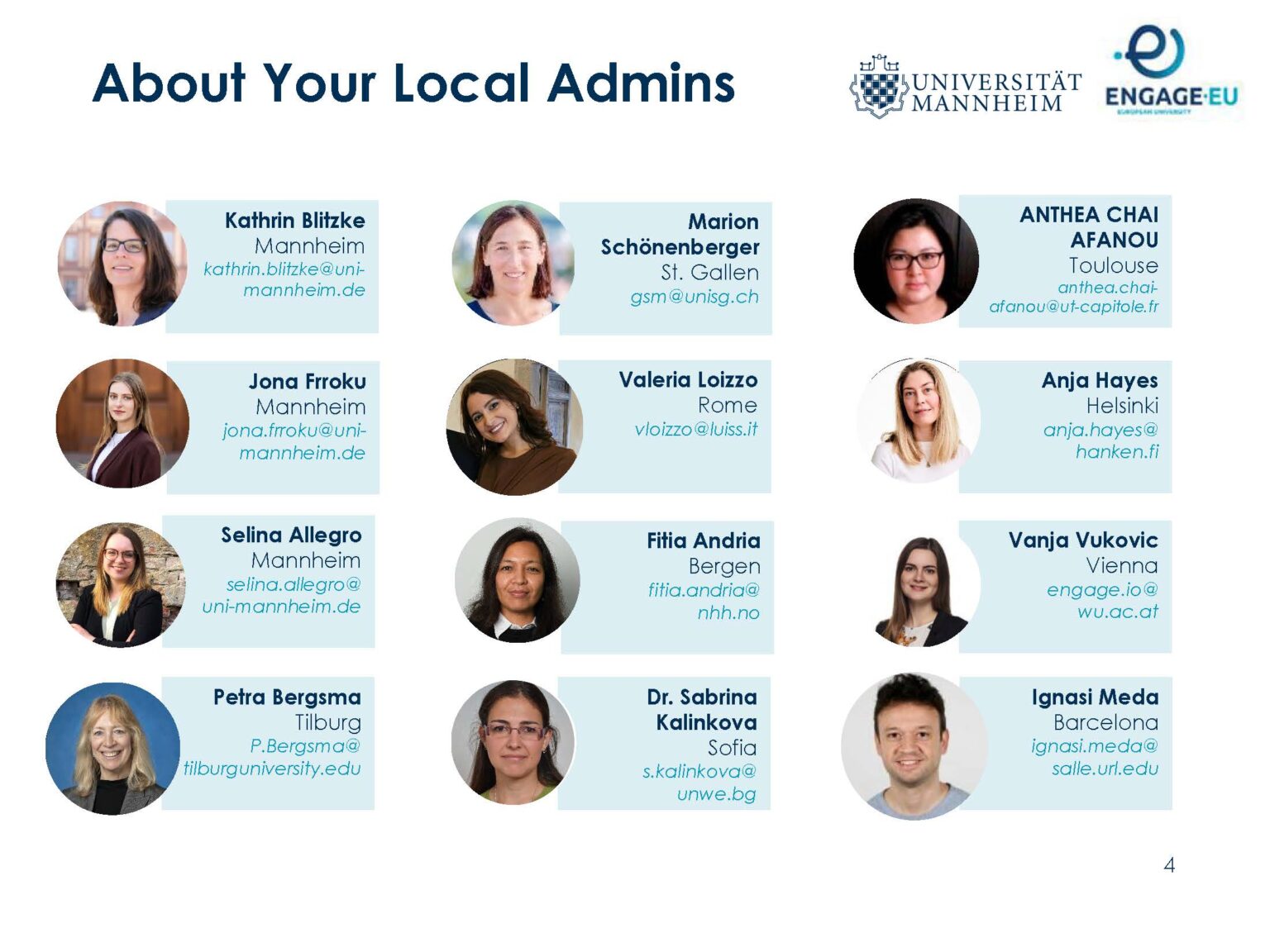
Kathrin Blitzke

ENGAGE.EU Local Work Package Coordinator ENGAGE.EU Programmes (WP3)

Working from home every Monday, Wednesday and Friday; available only via E-Mail on these days.

University of Mannheim
Division II – Student Affairs
International Office
L 1, 1 – Room 107
68161 Mannheim

Phone: +49 621 181–1159
E-mail: kathrin.blitzke@uni-mannheim.de

Victoria Meil, M.Sc.

Chair of Quantitative Marketing and Consumer Analytics

University of Mannheim
Mannheim Business School
L 5, 2
68161 Mannheim

E-mail: victoria.meil@uni-mannheim.de

Selina Allegro, M.Sc.

Project Management ENGAGE.EU Short Programmes

University of Mannheim
Teaching and Learning Center
L 9, 6 – Room 007
68161 Mannheim

 
Tel.: +49 621 181–2162
E-mail: selina.allegro@uni-mannheim.de